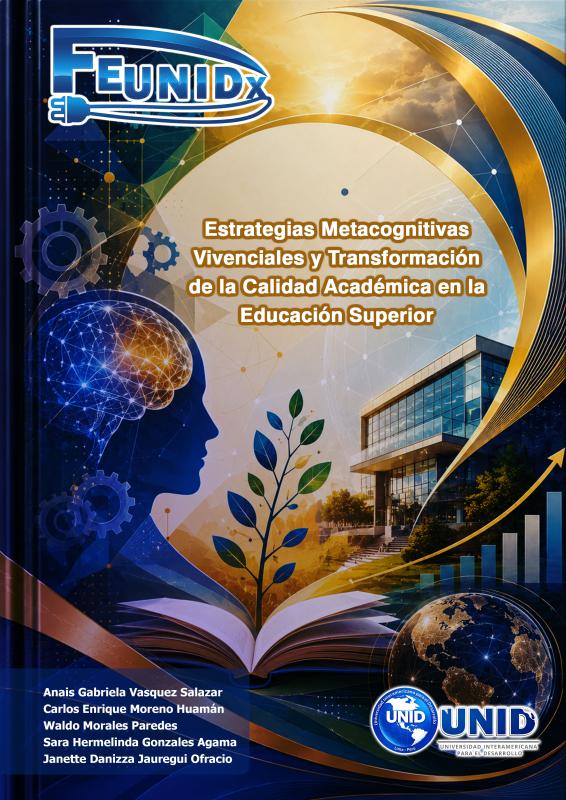

El libro Estrategias Metacognitivas Vivenciales y Transformación de la Calidad Académica en la Educación Superior analiza cómo la metacognición fortalece la calidad académica al desarrollar estudiantes capaces de planificar, monitorear y evaluar su propio aprendizaje. Expone los fundamentos psicológicos y pedagógicos de la metacognición, su relación con el aprendizaje autorregulado, la resiliencia, la autoeficacia y el pensamiento crítico, así como su integración con tecnologías educativas e inteligencia artificial. Además, propone estrategias metacognitivas vivenciales que vinculan la reflexión con experiencias de aprendizaje significativas, favoreciendo la autonomía, la innovación y la mejora continua en la educación superior, con el propósito de formar profesionales preparados para responder a los desafíos de la sociedad del conocimiento.
Abdellah, R. (2015). Metacognitive awareness and its relation to academic achievement and teaching performance of pre-service female teachers in Ajman University in UAE. Procedia - Social and Behavioral Sciences, 174, 560–567.
Al-Azzemy, A. F. T., & Al-Jamal, D. A. H. (2019). Evaluating cognitive, metacognitive and social listening comprehension teaching strategies in Kuwaiti classrooms. Heliyon, 5(2), e01264. https://doi.org/10.1016/j.heliyon.2019.e01264
Alsaiari, A., et al. (2026). Metacognitive awareness and academic performance in higher education. Higher Education Studies.
Andargeery, S. Y., & Taani, M. H. (2026). Psychological distress linking quality of learning experience to academic burnout among nursing students: A single mediation analysis. Nurse Education Today.
Becker, B. A., Goslin, K., & Glanville, G. (2018). The importance of metacognition in introductory programming education. Proceedings of the ACM Conference on Innovation and Technology in Computer Science Education.
Bergin, S., Reilly, R., & Traynor, D. (2005). Examining the role of self-regulated learning on introductory programming performance. Proceedings of the International Workshop on Computing Education Research.
Bonar, J., & Soloway, E. (1989). Preprogramming knowledge: A major source of misconceptions in novice programmers. Human–Computer Interaction, 4(2), 133–161.
Cai, Y. (2025). Growth mindset and academic self-regulation among university students. Educational Psychology Review.
Çakıroğlu, Ü., & Er, B. (2023). A model to develop activities for teaching programming through metacognitive strategies. Thinking Skills and Creativity, 48, 101279. https://doi.org/10.1016/j.tsc.2023.101279
Chen, Y. (2026). Metacognitive scaffolding in immersive virtual learning environments. Computers & Education.
Corrigan, J. A., & Forzani, E. (2025). Emerging and established readers’ cognitive and metacognitive strategies during online evaluation. Computers & Education.
Cruz, A. F. P., Pereira, W. D. S., Ribeiro, N. G., Sousa, J. N., Macedo, M. T. S., Baldo, T. O. F., & Baldo, M. P. (2026). Anxiety in the academic environment: Impacts on quality of life and well-being of university students. International Journal of Educational Research, 136, 102916.
Danielak, B. A. (2019). Investigating metacognitive development in engineering education. Journal of Engineering Education.
Denny, P., Luxton-Reilly, A., & Simon, B. (2019). Measuring metacognition in computer science education. Computer Science Education.
Dignath, C., & Büttner, G. (2008). Components of fostering self-regulated learning among students. Meta-analysis of Intervention Studies.
Ellis, A. K., Denton, D. W., & Bond, J. B. (2014). An analysis of research on metacognitive teaching strategies. Procedia - Social and Behavioral Sciences, 116, 4015–4024. https://doi.org/10.1016/j.sbspro.2014.01.883
Fatmawati, E., et al. (2026). Metacognitive strategies and academic achievement among university students. Educational Sciences Journal.
Fahrni, D. D., Hascher, T., & Prasse, D. (2025). Promoting metacognitive strategies with educational technology: Primary teachers’ beliefs and practices. Computers & Education.
Flavell, J. H. (1976). Metacognitive aspects of problem solving. In L. B. Resnick (Ed.), The nature of intelligence (pp. 231–235). Lawrence Erlbaum Associates.
Flavell, J. H. (1979). Metacognition and cognitive monitoring: A new area of cognitive-developmental inquiry. American Psychologist, 34(10), 906–911. https://doi.org/10.1037/0003-066X.34.10.906
Fontao, C. B., López Santos, M., & Arias-Gago, A. R. (2024). Metacognitive analysis of the practicum subject of the Master’s in Secondary Teaching through a reflexive portfolio. Heliyon, 10, e32633.
Jung, E., et al. (2026). Metacognitive regulation and academic performance in higher education. Educational Psychology.
Kumar, A., et al. (2005). Problem solving and programming learning. Computer Science Education.
Law, K., Lee, Y., & Yu, Y. (2010). Learning motivation and metacognition in programming education. Journal of Educational Computing Research.
Lin, G.-Y., Juan, S.-J., Chen, Y.-H., & Wang, Y.-S. (2026). Determinants of educational metaverse adoption intentions among business and management undergraduates. The International Journal of Management Education, 24, 101422.
Liu, D., & He, C. (2026). Growth mindset and academic resilience: The mediating role of grit among Chinese university students. Current Psychology.
Loksa, D., Ko, A. J., Jernigan, W., Oleson, A., Mendez, C., & Burnett, M. (2016). Programming, problem solving, and metacognition. Proceedings of the ACM Conference on International Computing Education Research.
McGill, T., & Volet, S. (1997). A conceptual framework for analyzing students’ knowledge of programming. Journal of Research on Computing in Education.
Mojarad, F. A., et al. (2013). The impact of metacognitive instruction on self-efficacy and academic achievement. Procedia - Social and Behavioral Sciences.
Murphy-Graham, E., Lample, J., Kabay, S., & Nourani, V. (2025). Transformative teacher professional development: A qualitative case study of a metacognitive approach to teacher training in Uganda. Teaching and Teacher Education.
Namaziandost, E. (2026). Metacognitive strategies and self-regulated learning in higher education. Journal of Educational Psychology.
Ngo, T. T. A., Bui, C. T., Chau, H. K. L., Tran, N. P. N., Nguyen, P. P. T., & Tran, N. K. T. (2025). Influence of university service quality on student experiences, academic performance and institutional loyalty: A case study in Vietnam. Acta Psychologica, 260, 105599.
Ohle-Peters, A., & McElvany, N. (2026). Fostering pre-service teachers’ classroom management in an inclusive classroom: How effective are serious educational games? Teaching and Teacher Education.
Pedrosa, D., Cravino, J., Morgado, L., & Barreira, C. (2016). Metacognitive tools and reflective learning in higher education. Educational Technology Research and Development.
Prather, J., Pettit, R., McMurry, K., Peters, A., Homer, J., & Cohen, M. (2018). Metacognitive difficulties in novice programmers. Proceedings of the ACM Technical Symposium on Computer Science Education.
Rahimi, M., & Katal, M. (2013). The relationship between metacognitive awareness and listening comprehension. International Journal of Listening.
Rohatgi, A., & Hatlevik, O. E. (2025). Metacognition and self-regulated learning in higher education. Learning and Individual Differences.
Schraw, G. (1998). Promoting general metacognitive awareness. Instructional Science, 26(1–2), 113–125.
Schraw, G., & Moshman, D. (1995). Metacognitive theories. Educational Psychology Review, 7(4), 351–371.
Stillman, G., & Mevarech, Z. (2010). Metacognition research in mathematics and problem solving. Educational Studies in Mathematics.
Whitebread, D., Coltman, P., Pino Pasternak, D., Sangster, C., Grau, V., Bingham, S., Almeqdad, Q., & Demetriou, D. (2009). The development of two observational tools for assessing metacognition and self-regulated learning in young children. Metacognition and Learning, 4(1), 63–85.
Winne, P. H. (2018). Cognition and metacognition within self-regulated learning. In D. H. Schunk & J. A. Greene (Eds.), Handbook of self-regulation of learning and performance (2nd ed., pp. 36–48). Routledge.
Xiao, Y., Liu, X., & Yao, Y. (2025). Students’ development of AI metacognitive awareness in an EAP course: A qualitative inspection through the Experiential Learning Theory. System, 133, 103790.
Xu, W., Sun, Y., Yao, Y., & Zhu, X. (2025). Examining the relationships among growth mindset, future selves, metacognitive strategy use and L2 writing performance: A self-regulatory loop. System, 133, 103748.
Zhou, X., Sidhu, G. K., & Wang, L. (2026). Academic buoyancy in EFL learning: A mixed-methods study among Chinese private university students. Acta Psychologica, 267, 106990.
Zhussupova, R., & Kazbekova, M. (2016). Metacognitive strategies as points in teaching reading comprehension. Procedia - Social and Behavioral Sciences, 228, 593–600. https://doi.org/10.1016/j.sbspro.2016.07.091